
The Piece That Started Everything
I didn't start JHGWoodCraft by taking a commission.
I started it by solving a problem for the woman I love — and discovering that the problem I solved for her was the same problem a lot of people have, and nobody was solving it well.
What She Asked For
My wife wanted a place to keep her medication. Secure, accessible, and nothing like a medicine cabinet. She wanted something that didn't make the bedroom feel clinical. Something that didn't announce itself. Something that, if a guest walked into the room, they'd never know was there.
She also wanted a new bed frame. The old one didn't work with the articulating base she needed.
I told her I had some ideas.
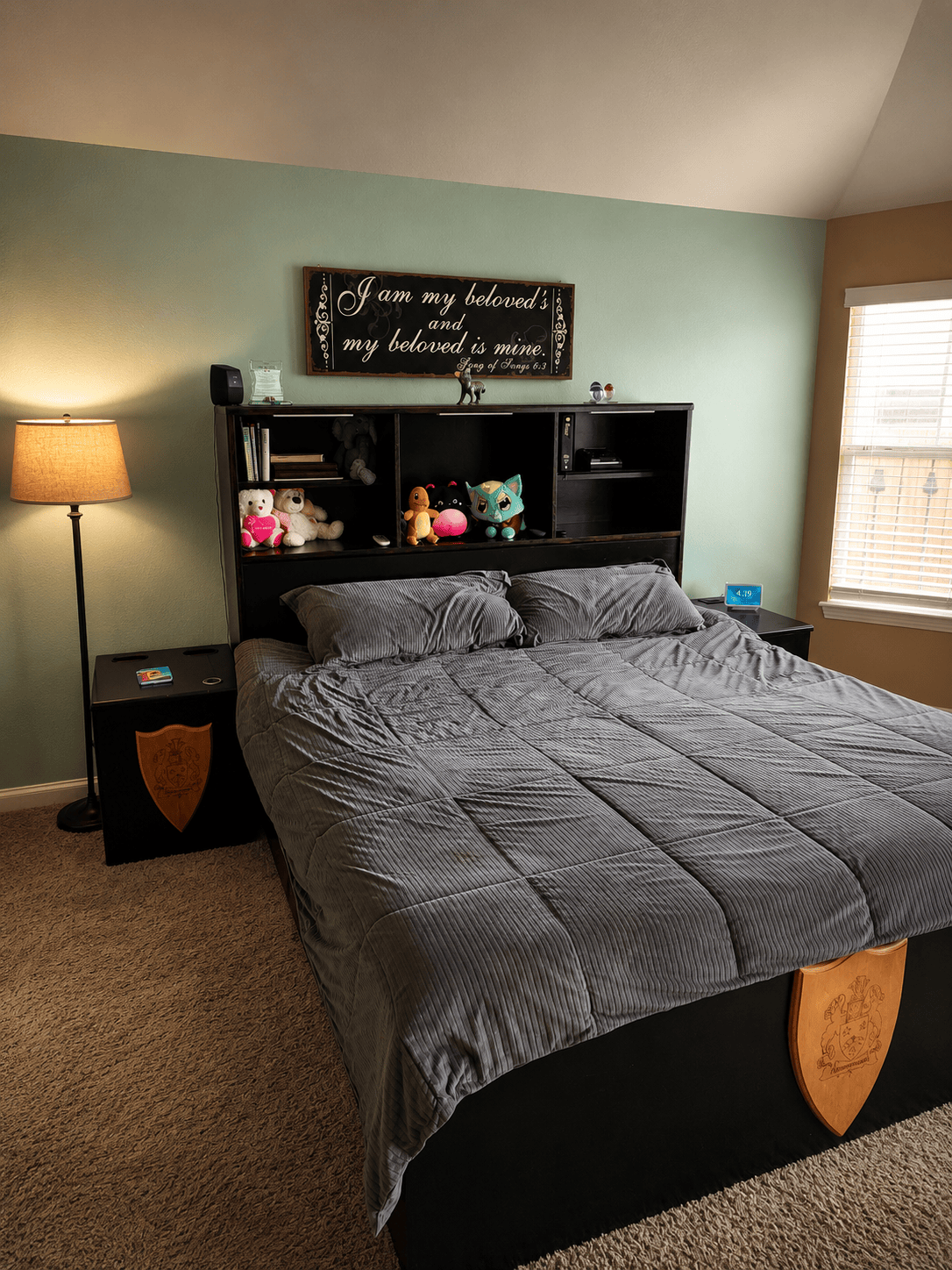
What I ended up building was something I didn't have a name for yet — what I now call a concealment suite.
The Build
The frame is Bombay mahogany. I chose it for the color, depth of the grain and the way it ages — mahogany doesn't just hold up, it gets better. Harder finishes become more beautiful. The color deepens over decades. I wanted something that would outlast both of us.
The headboard is lighted — warm, dimmable, the kind of light that belongs in a bedroom rather than fighting with it. The lighting is fully internal, routed before assembly so there are no visible cables, no interruptions in the wood surface. From the outside, it's a headboard.
Each side table has a biometric lock built into the front panel. The sensor responds quickly. Press, unlock, the front panel opens. Her medication is in a concealed drawer — accessible to her easily even in the dark, invisible to anyone who doesn't know it's there.
My side holds my .45..... and hopefully its never needed.
The lock positions were chosen during the design phase, before a single piece of wood was cut — because when you're integrating technology into hardwood furniture, you don't retrofit. You engineer it from the beginning or you compromise both the furniture and the function.
What I Learned From Building It
Two things.
First: the concealment only works when the furniture is extraordinary. If the piece is average, people look harder. They notice seams. They wonder. But when a piece is genuinely beautiful — when the grain is matched, the joinery is clean, may have a unique feature to draw the eye, the finish is right — people don't interrogate it. They admire it. And what they don't look for, they don't find.
Security through excellence. That's what I was building, even before I had language for it.
Second: this problem is not unique to my wife. Almost everyone has something valuable they want accessible but invisible. Medication. Documents. Firearms. Cash. Jewelry. The things that matter most tend to be the things people least want on display — and the current market solution is either a gun safe that announces itself from across the room, or a hidden compartment that looks like a hidden compartment.
Neither is right. And neither is what I built for her.
The Piece That Still Sits in Our Bedroom
That suite is still there. Years later. The biometric locks still respond, though on her side I did adjust it for a RFID as was more her preference. The mahogany has deepened exactly the way I expected. The lighting still works.
My wife still uses the drawer every morning. She's never had to fumble with a key or remember a combination. It just works — invisibly, beautifully, exactly as designed.
That piece is why JHGWoodCraft exists.
Every commission I take is an attempt to do for someone else what I did for her — build something so beautiful that the concealment becomes secondary to the craft, and so functional that the craft disappears when it needs to.
---
*If you have something you've been trying to figure out how to secure — a firearm, a medication, valuables, a room — the design consultation is always free. Bring the problem. We'll figure out the piece.*